
Gender diversity in STEM* careers enhances society, is good for business and has a positive impact on future generations. Throughout the spring of 2022, IMA has been raising the profiles of the outstanding women across our Network to share their ideas about leadership, chosen career paths and their advice for the next generation.
What is your name, job title and area of work?
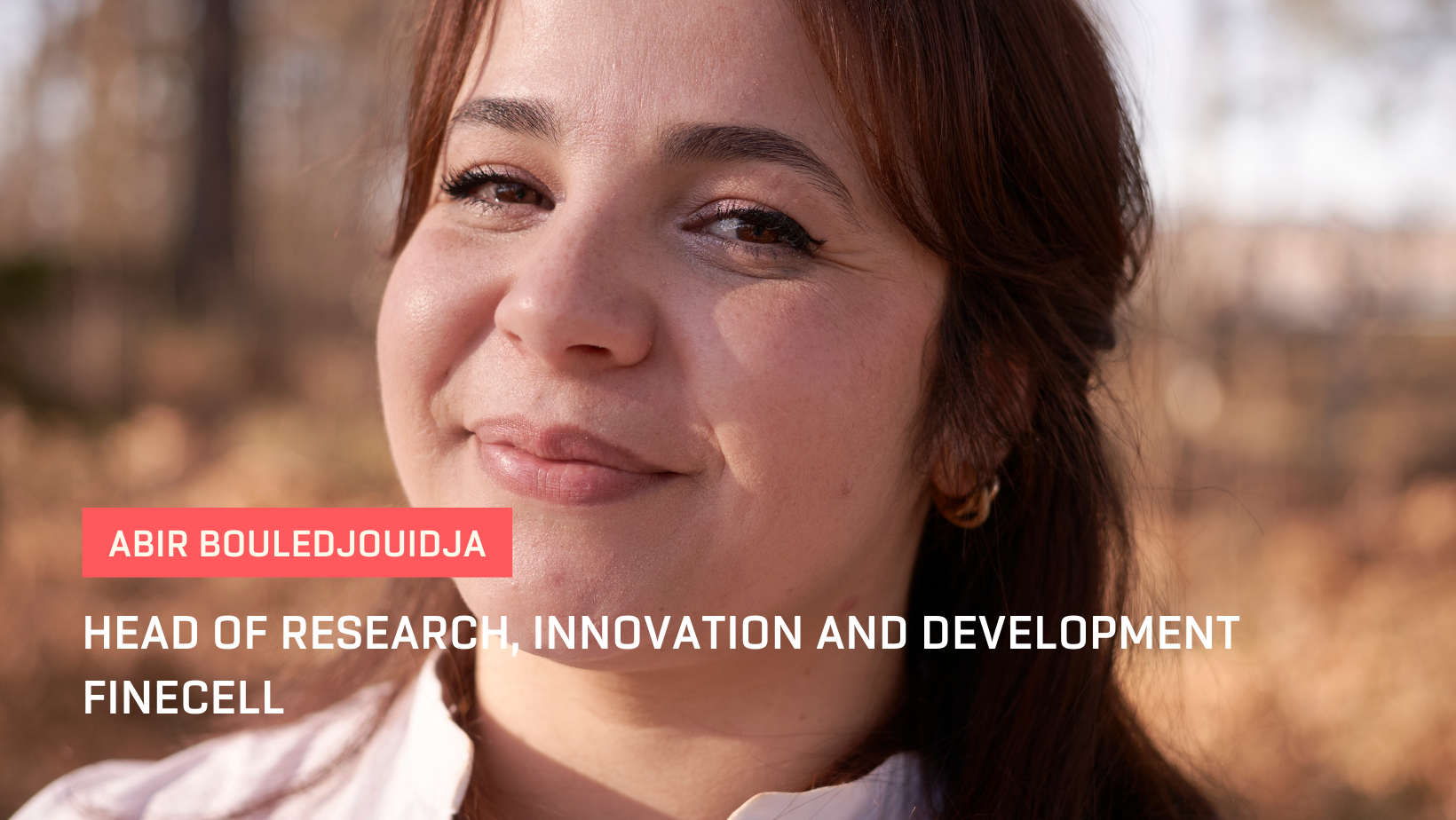
Abir Bouledjouidja, PhD, currently working as a Head of Research, Innovation and Development at FineCell.
You have a PhD degree in Materials science and 9 years experience working with R&I, product development and scale-up. What sparked your interest in Materials science? What led you to pursue a career in this field?
I was always fascinated by nature and how plants grow and this is how I got into Engineering. I have a background in Chemical Engineering. Chemistry was the answer to almost everything I wanted to know about nature, so the choice was natural to me. I decided to do a PhD in Materials Science and Green Process because of my thirst for knowledge. This field allowed me to strengthen my knowledge about material and chemistry but also to learn the process needed to produce different new materials and products. After two years as researcher/lecturer at Polytech Grenoble and IUT de Grenoble, I started my first experience in a Tech start-up where I was in charge of the technical development of innovative products from scratch until scale-up and commercialization.
Tell us about your experience working in a start-up!
We started off with an empty laboratory and two people in the technical side and grew into a team of 22 people with 11 people in my team, among them technicians, engineers and doctors. My job was to establish strategy and develop products from an idea inside our lab to the commercial stage. I loved the whole experience of growing with the company, being in the mind-set of the client, scaling-up the process, and it also helped me realise that this is something I want to work with for the rest of my life – creating and developing new products while respecting my values and things I care about most.
What’s it like working as a Head of Research & Innovation?
Being a Head of Research and Innovation means I am in charge of developing the process, products and applications within the company. I develop and optimize the process to produce different products, source raw materials and equipment we need to use and identify the final commercial applications which are suitable for our products. I am also in charge of the Patents in the company and the collaborations with universities, industrials partners and some clients. My job is a combination of lab work, scale-up, collaboration with industrial/academic partners, travelling, meeting clients in order to reach the company goals and meet our customers’ needs and specifications.
What is the most satisfying thing about your job?
It’s going from an idea to a final commercial product. It’s amazing to see the growth, and if you are involved in this process, you will learn a lot and get new ideas. It’s also the appeal of doing something that is aligned with my values, things I care about – like nature – and developing a solution that is both useful and respectful of the environment.
You have had an impressive career back in France and the UK. What inspired you to move to Sweden? Do you notice much difference between how things work in the industry sector here in Sweden and France?
I often heard about the Scandinavian lifestyle where work and private life are kept in balance and I wanted to learn more about it. It’s fascinating how people here do a lot of things by working smarter, not harder. In France, we have a tendency to overwork and it can be quite intense. Another reason why I came to Sweden is the great outdoors and nature
What, in your opinion, is important do think about when we talk about inclusivity and diversity, including gender diversity within STEM?
I think diversity is something that we have to think about and accept from an early age, not when we are older. This is something that we should learn from our parents, school and environment. Our environment still acts on the old stereotypes of what men and women should do, and this shapes kids’ life because growing up, girls might think that they are not suited for building cars, working in IT and doing other tech-jobs. I think one way to ensure diversity lies through giving young children the freedom of being themselves without judging their choices and behaviours in boxes in order to let them choose what they really want to do. We have seen progress when compared to previous generations, but we have still a lot of work to do!
You are an experienced team manager. What is your take on leadership, what makes a good leader?
A good leader is somebody who leads by example, is honest with their team and gains trust of their employees.
What is the best career advice you were given as a young professional? What advice would you now give to aspiring young female leaders and women considering a career in STEM?
The best advice I received was to not to be afraid to do my own thing and trust myself. Remember that you don’t need to be perfect and know everything to try new things or start a business. As for my advice to the younger generation, I’d say this: keep learning, try new things, meet new people, be tolerant and know what you want. We are all unique and brilliant when we found our own purpose!
*STEM stands for Science, Technology, Engineering and Mathematics.
About FineCell
FineCell, a spin-off company from KTH Royal Institute of Technology, offers sustainable cellulose microfibers which help manufacturers make new products with improved performance, differentiated properties and reduce environmental impact. You can read more about FineCell in our Sustainability Story.