
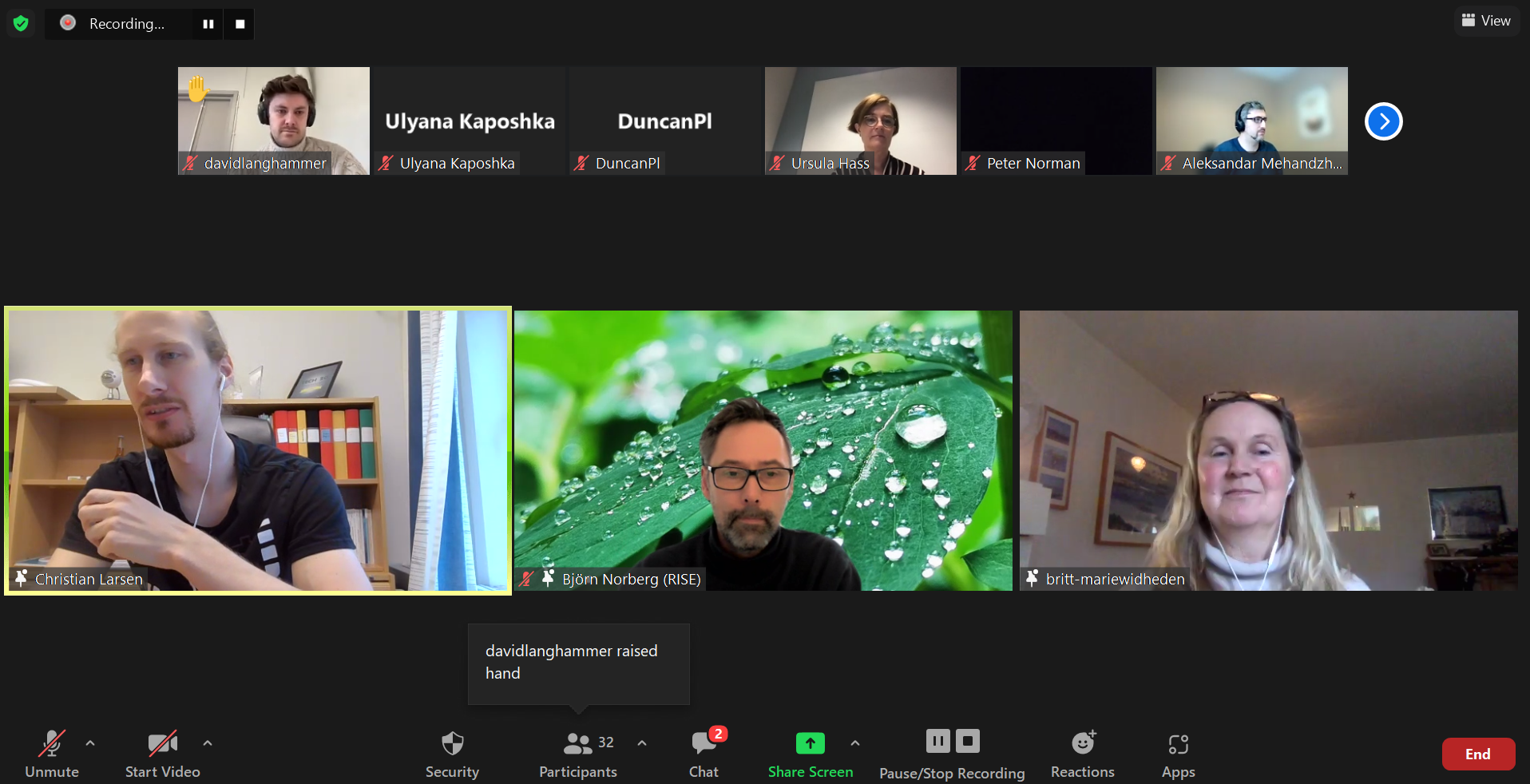
Establishing green solvents has become an increasingly important area of research. Several solvent selection guides outline hazardous solvents that should be avoided in the lab facilities and industrial settings – but how does one go from theory to practice? How do we define green and functional solvents? How do different methodologies practically enhance greenness of chemical processes? IMA has invited guest speakers from Umeå universitet, Linköpings universitet and RISE to share their thoughts on this subject and discuss solvent selection in more details.
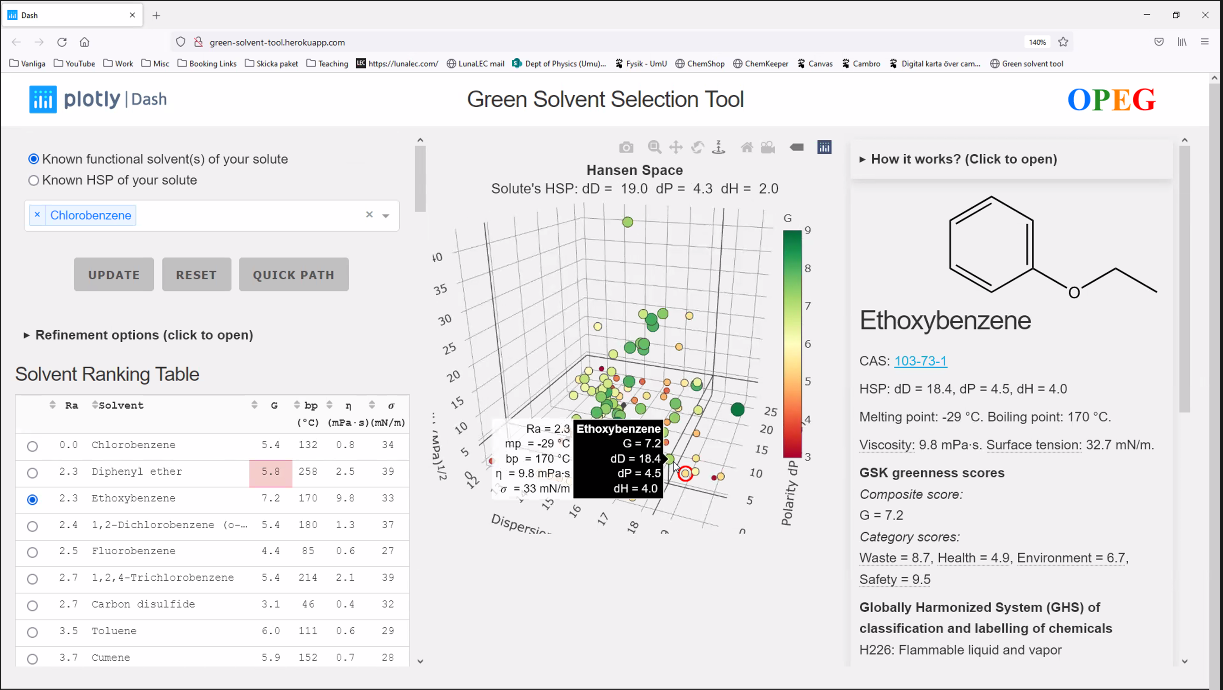
Christian Larsen from Umeå universitet took us on the tour of green solvents and their newly developed web-tool to green solvent selection. Christian broke down the definition of greenness using the GSK sustainability guide and explained what parameters are used in calculating the final ”green” score – parameters such as health hazard, exposure potential, air impact, flammability, recycling, bio treatment and others. The green solvent selection tool created by Christian and his team makes it easy to identify and find functional green solvents. It also allows you to filter certain properties. The tool is offered for free use and can be accessed through this link.
Serious concerns are being raised in the fast growing area of printed electronics where printing and coating solvents are used during fabrication. Many of them contain toxic substances that are harmful to both humans and the environment. Robert Brooke from Norrköping-based Printed Electronics Arena (PEA)/RISE shared with us some insights of how they ensure the safety of their employees and assess whether some inks can be used in their open print workshop at PEA.
Igor Zozoulenko, Prof. from Linköpings universitet, and Aleksandar Mehandzhiyski presented their COSMO-RS solution for solvent selection and optimisation based on different criteria such as partition coefficients, vapor pressures, sigma profiles and more. They showcased the study they did on designing deep eutectic solvents to extract antioxidants from rosemary, using the COSMO-RS tool.
Anna Jacobs from Substitutionscentrum provided some information on methodology guides offered by RISE, particularly ”Alternatives Assessment” and Rapid Substitution Tool. The latter provides users with a list of alternatives based on toxicity, chemical properties, smell and price. The tool can be used in research as well as industrial settings.
Watch live recording March 10th 2022
Guest speakers’ presentations
Presentation by Christian Larsen, Umeå universitet
Presentation by Anna Jacobs, Substitutionscentrum
Would you like to know more about IMA, our current projects and upcoming events? Get in touch with us!
Ingela Lindahl, PhD, Acting COO & Project Manager for IMA Sustain
E-mail: Ingela.Lindahl@innovativematerials.se. Phone: 070-720 83 13
Ulyana Kaposhka, Communications Officer
E-mail: ulyana.kaposhka@innovativematerials.se. Phone: 070-002 65 60
Useful links
Larsen Christian, Lundberg Petter, Tang Shi, Ràfols-Ribé Joan, Sandström Andreas, Lindh Mattias E., Wang Julia & Edman Ludwig (2021). A tool for identifying green solvents for printed electronics. Nature Communications, 12:4510. Accessible online at: https://www.nature.com/articles/s41467-021-24761-x.pdf