
The Wematter company works with sustainability and is environmentally friendly with their 3D printing. Let’s get to know the company and get to the bottom with some questions!
Wematter, a company founded in 2014 and based in Linköping, is a Swedish 3D printer manufacturer. The company makes advanced industrial technology available in a user-friendly, all-in-one solution that includes hardware and software. This tech allows customers to produce things like chainsaws, prosthetic bones, and robotic arms right where they are needed.
Wematter saves working time and lowers barriers to investment by focusing its efforts on user-friendliness. Its 3D printing solution lowers the threshold for on-site use in customers’ office, manufacturing, and development environments, thus creating new commercial opportunities. Wematter’s SLS technology gives companies the ability to quickly prototype their ideas. The technology increases engineering efficiency and has a positive effect on the environment.
We have a strong vision that tomorrow’s product will be made locally and globally at the same time. Big factories located far away from the customer, building up huge stock and transporting goods all over the world are the image of a bygone era.. The future is On Site, and the future is sustainable when parts are made at the customers’ office or workshop”, says Robert Kniola, CEO at Wematter.
Wematter is an acclaimed practitioner of sustainable business models. Can you describe your business model and how it advances your sustainability efforts?
Wematter Business model relies on rental of equipment and software, and paying per kilo powder.
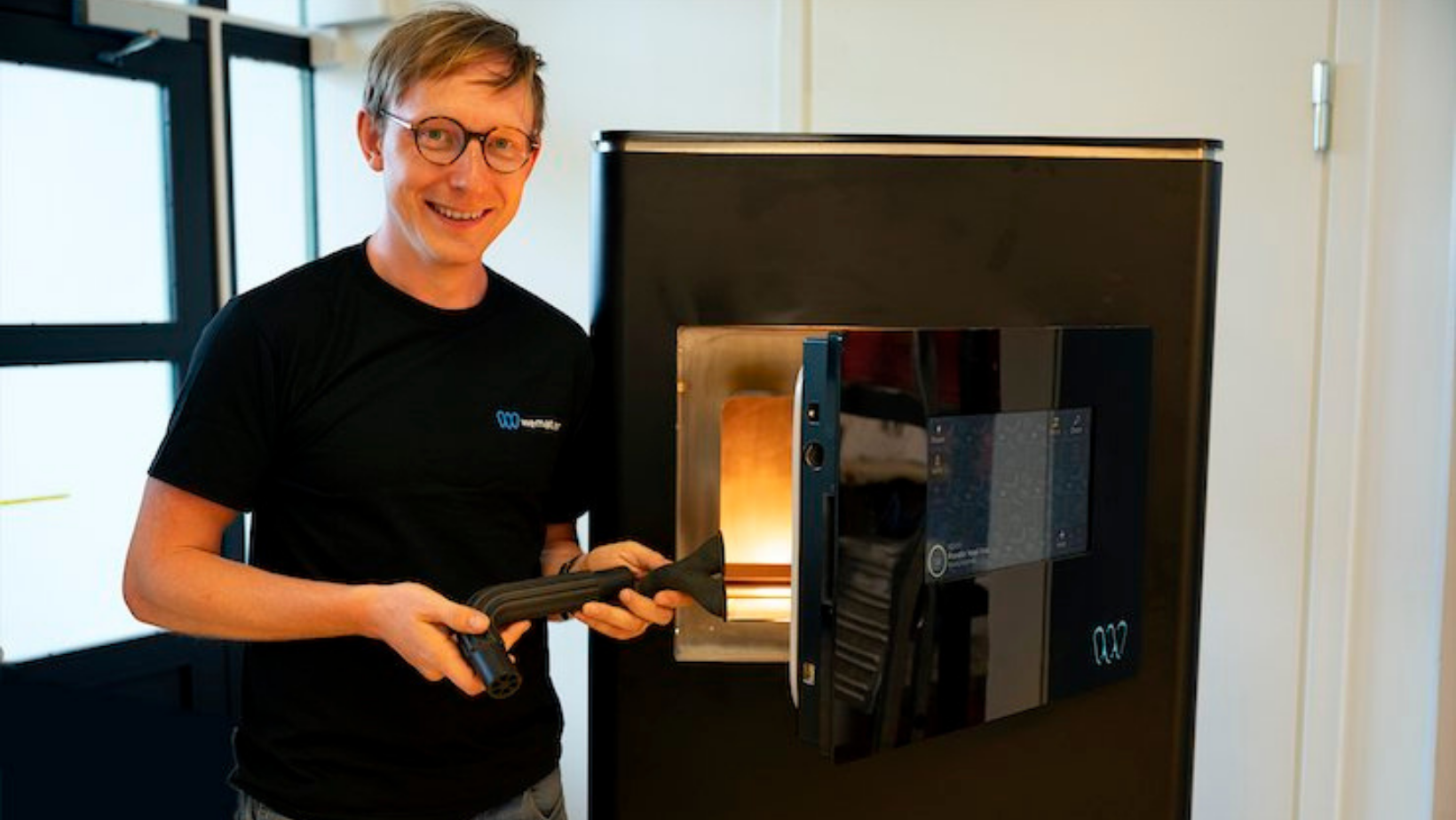
Wematter manufactures and rents out SLS-3D printers that use polymers for print material. The company’s ecosystem includes the Gravity 3D printer, the Density cleaning cabinet, Deep Space Cloud software, and Aurora powder material.
Wematter also focuses on its additive manufacturing process. The behaviour prevalent in industrial manufacturing currently relies on cyclical replacement and material waste. Investments in expensive industrial equipment occur on a regular basis, but Wematter’s equipment rental model means that industrial production remains evergreen. The manufacturer no longer worries about cyclical replacement, nor does it plan for material waste due to unused components or subtractive manufacturing processes. Wematter’s customers leave equipment maintenance to Wematter; customers focus on the cost of operating their business, not on large investments and subsequent upkeep.
We only ask that the customers return unused powder from the print process. When the powder comes back to Wematter, we put it through a quality control process and mix satisfactory material in with new powder. It is then redistributed to customers that are able to use recycled powder to produce objects used, for example, in education or for anatomical models.
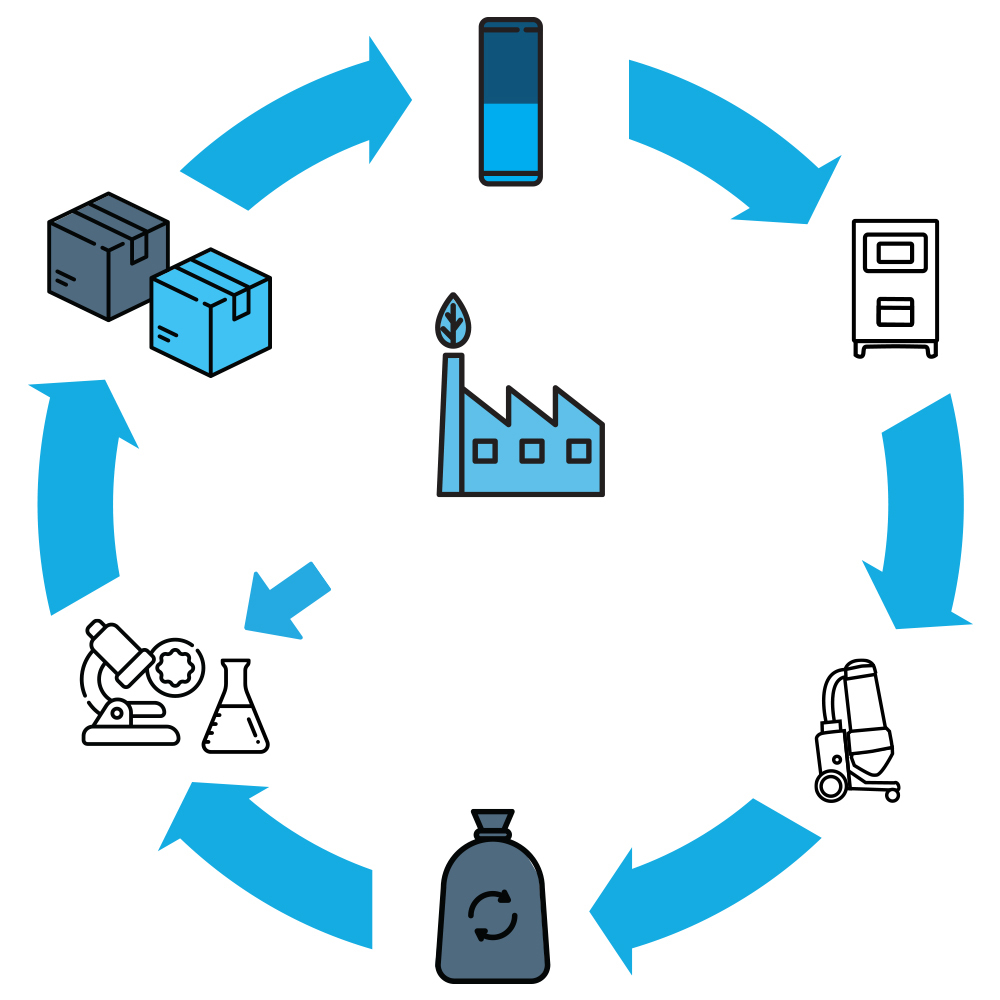
The powder cycle: Wematters customers only need to return used powder, no equipment needed. The powder can get reused up to 100%. In this way Wematter works for a better environment and sustainability.
How much do your customers appreciate the rental solution?
Things that customers appreciate about the rental model:
- Fixed monthly cost;
- No large investment cost;
- Funds are diverted toward the customer’s operation instead of equipment investment, which does burdens the balance sheet less;
- All-inclusive installation, service, repair, and support;
- Move away from wear-and-tear behaviour, which is more sustainable;
- No need to plan equipment transportation to a work site, installation, nor possible removal at the end of its life cycle;
- Always upgrade to the latest version of both software and hardware.
The 3D printing industry is considered eco-friendly but it is a quite energy thirsty process. How much less energy do your 3D printers use at the production stage compared to machining?
500W in operation compared to CNC mills, which can be between 7 & 24kW. That’s a saving of 14-48 times!
How much more sustainable would it be, in your opinion, to use heat or a laser to melt plastic? Do you see yourself able to do this in the future?
We use three heat sources to melt our polymers: conductive heat, radiation, and laser.
https://www.youtube.com/watch?v=N164WFE72zU
Most 3D printers use plastics which is good because it can be recycled but it is not exactly the “greenest” material. What other, more environmentally friendly, materials or waste materials can be used in 3D printing, based on your research and experience? Are Wematters printers compatible with materials other than plastic?
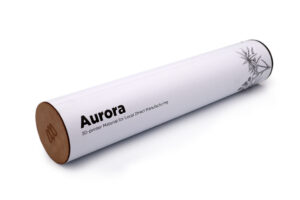
Our standard material Aurora PA11 is sold in the largest volume and also able to replace materials such as aluminum because it is recycable, durable and light weight. We use bio-based components in both our polymers and our composites. We are also conducting research on new bio-based materials, such as Nanocellulose-based powder that reduces the amount of Polymer needed from 100% to 60 % per kilogram. We have also used powders that incorporate biobased carbon fibers instead of more common synthetic fibers.
Wematters standard Aurora PA11- bio based & sustainable material is reenewable, recyclable, durable and lightweight.
3D printing has potential to reduce material use, what other areas can benefit from 3D-printing growth?
Bespoke applications, such as orthopedic solutions and other health care applications. Additive manufacturing also prolongs the life of manufacturing equipment, factories, and other machinery that has reached their end of their traditional industrial life cycle. Other applications can be areas with low volume, where there is a small business value that can be executed with AM and Wematter by lowering the barriers to entry.
How do you work with sustainability within a company? Have you taken any initiatives to focus on the social impact or gender equality?
Wematter’s vision is to decentralize Additive manufacturing and make their 3D printer equipment easy to use for anybody. With Wematter’s software tool, customers can have a digital stock library instead of a warehouse with spare parts, and have their prints when needed. This makes it possible for the customers to place the company resource all over the organization. This way we as the customers can reduce travel costs, save money and time as well as share knowledge within the entire organization.
Another sustainable way of doing things is reducing material waste. Wematter collects the used powder from customers and reuses it on other segments like education where the requirement to have new powder all the time is not prioritised. In addition, the material we work with Aurora PA11 which is our standard material is bio-based which also contributes to sustainability.
Wematter’s solution can easily be used in regions where the investment hinder the adoption, both in terms of knowledge and economics.
What is Wematter’s biggest challenge as a business?
Wematter must continue to scale its operations to meet increasing demand for its SLS 3D printing machines.
We see this as an opportunity rather than a challenge. We want to keep doing what we do best, which is making readily available SLS 3D printers for every office. As demand has increased, we need to make sure that we continue to grow as a company, by finding people with the right skills to incorporate into our vision. Wematter is working hard on these fronts. We are outgrowing our current premises and need to balance production and office space. Financing is another challenge that we are in the process of overcoming with strong growth. There are many pieces of the puzzle that need to be in place, which is, in turn, itself a challenge, but as I said also an opportunity”, says Robert Kniola, CEO of Wematter.
Did you know?
Wematter was also involved in creating a 3D-printed orthosis for our COO Pia Lindström back in 2019 – the orthosis was first in Sweden to replace traditional orthopedic plaster. This became an inspiration for us to start our 3D/AM 4 Healthcare focus group and webinar series of the same name one year later. You can read the full story here.
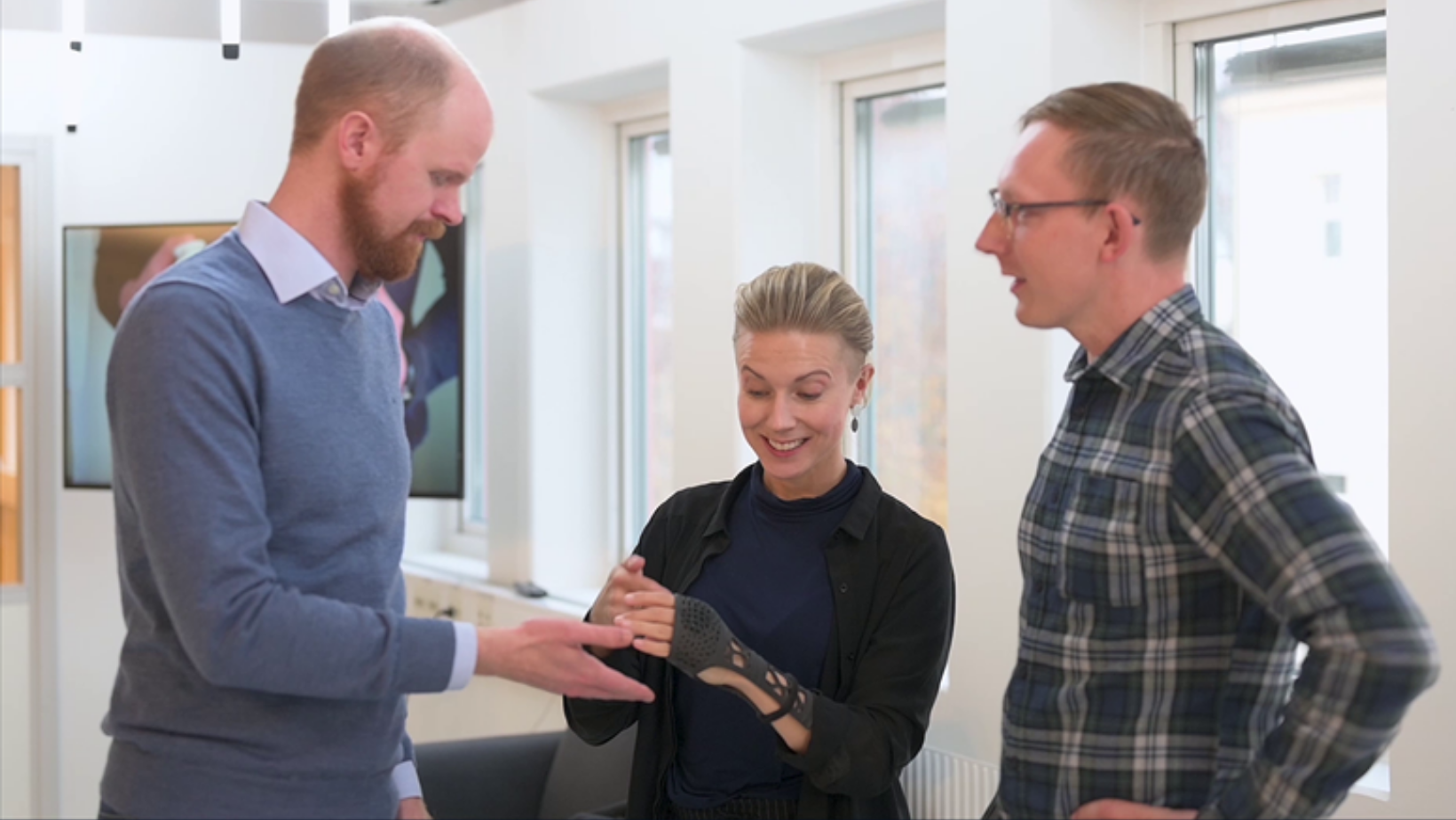
Kristofer Skyttner (Skymaker), Pia Lindström and Robert Kniola.
Photos and video: Wematter.